Learn & Design
The oil film in a loaded gear mesh is usually thinner than the roughness it has to bridge. Everything on this site follows from that one fact: which grade, which class, which oil to buy, and whether it will survive.
Where the limits sit depends on who you read: Dudley puts them at λ 0.4 and 1.0, ISO/TR 18792 at 0.7 and 2, NASA at 1 and 4. The picture is the same in every source.
AGMA 925-B22 Annex H; ISO/TR 18792 §3.8; NASA SP-237.
The slow set's film sits inside its own roughness band. That is a λ under 1, and it is why that gearbox micropits. The additive layer, a tenth of a micrometre, is what is actually keeping the steel apart.
Films: AGMA 925-B22 Annex D (0.14–0.30 µm, 309 rpm, ISO VG 460), Gear Solutions 2013-03 (3.0 µm). Roughness: AGMA 925-B22 Table 3. Additive layer: NASA SP-237. Hair and blood cell are general figures, not from a standard.
Design

Find my oil
Four questions: what it is, how fast, how hot, how cold it starts. ANSI/AGMA 9005-F16 gives the grade and class; the oils that fit are listed, buy button first, with a chart of each across your temperatures.
Find my oil »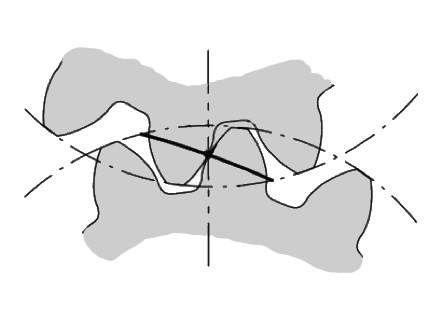
EHL analysis of a shortlist
Describe the gear pair and the duty once. AGMA 925-B22 is run along the whole tooth for every oil you shortlisted: film thickness, λ, wear risk and scuffing risk, with the film plotted from start to end of contact.
EHL analysis »
Pitch line velocity
Faster gears need thinner oils. The AGMA tables are indexed on the pitch line velocity of the slowest stage; work it out from rpm and pitch diameter here.
Calculate »Learn
How to choose an oil
Picking an oil for a machine looks daunting. The process is short, and this walks through it.
Read »
What each search box means
ISO grade, pour point, flash point, AGMA class, base oil, FZG stage: every box on Find & Buy in plain English.
Read »

Copper corrosion
Sulfur in a lubricant corrodes copper and bronze. How to recognise it and avoid it.
Read »
Viscosity index
How much an oil thins as it warms. A large part of price and of operating temperature range.
Read »


Synthetic or conventional for CNC
Synthetics are good, but a CNC machine is not a car. Here is why the case is weaker.
Read »Calculate
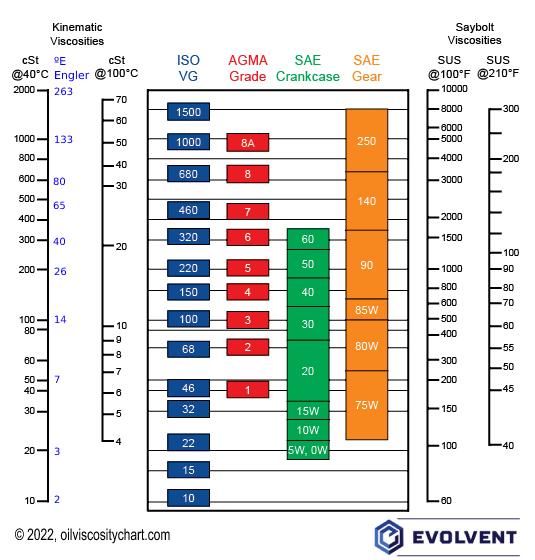
Convert ISO, AGMA and SAE
The three systems grade oils by viscosity. Convert between them; this is the first step in any selection.
Convert »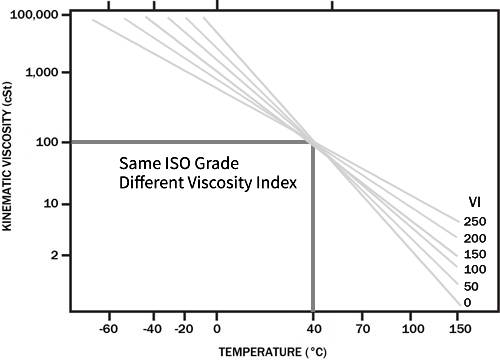
Viscosity index
From the viscosities at 40 °C and 100 °C, the index that says how the oil behaves across your temperature range.
Calculate »
Pitch line velocity
From rpm and pitch diameter. The number the AGMA viscosity tables are indexed on.
Calculate »