Learn about Machine Oils
Whether you just bought some new or old equipment, are maintaining your established machine shop, modifying a machine speed, or are just curious, we hope you learn something about lubrication
Find My Oil
Four questions about the gearbox: what it is, how fast, how hot, how cold it starts. The page applies ANSI/AGMA 9005-F16 and lists the oils that fit, buy button first, with a chart of how each behaves across your temperatures.
What Each Search Box Means
ISO grade, pour point, flash point, AGMA class, base oil type, FZG stage: every box on the Find & Buy search, explained in plain English. The same text is behind the "?" beside each box.
How to Choose an Oil for Your Machine
Picking an oil for a machine is daunting, but we walk through the process to make it simple

Synthetic or Conventional Oils for CNC
Synthetic oils are great, but don't offer the same benefits for CNC machines as they do cars. Here's why

Lubrication System Checklist
Here's what you need to check to keep your oil, and oil system (pumps, filters, etc.) are running smoothly

Lubricant-Induced Copper Corrosion
Sulfur in lubricants corrodes copper. Here's how to identify and avoid it!

List of Common Viscosities
A reference list of the viscosity of common fluids from Apple Puree to Whale Oil

All About Viscosity Index
One of the biggest determinants of price and operating temperature range, the Viscosity Index tells you how the oil changes with temperature.

Oil Terms Glossary
Here's a quick rundown on the most important terms you'll see when looking for an oil

Evolvent Design Blog
While Evolvent Design specializes in gears, they have a lot of content on oils and greases. Their blog combines mechanical history, shop tricks, and the science behind lubrication.

Calculate
Four calculators: convert between ISO, AGMA and SAE grades, work out a viscosity index, a pitch line velocity, or a regreasing interval.
Conversion Chart
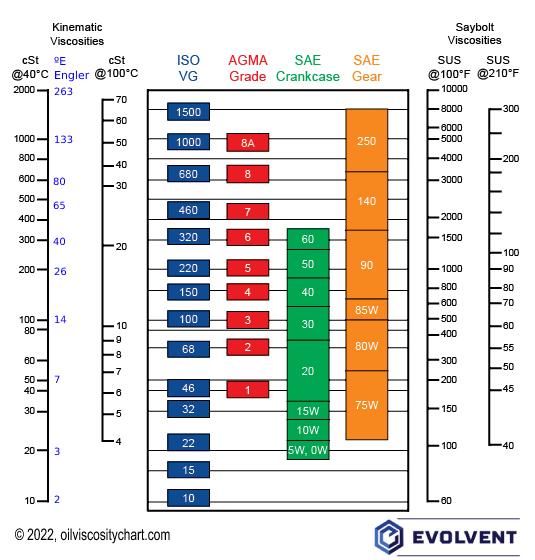
ISO, AGMA, and SAE all grade oils based on their viscosity; here's how you can convert between them (this is the first step)
Calculate Viscosity Index
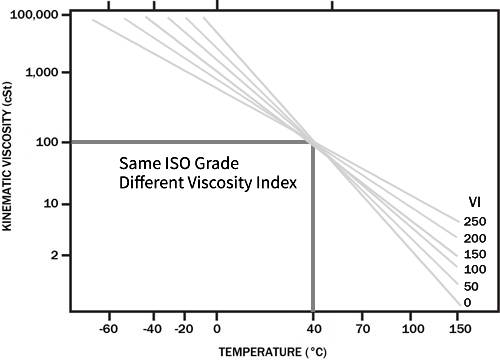
Viscosity changes with temperature, and Viscosity Index (VI) tells you how much. This calculator will tell you the viscosity index of your oil, so you can be sure it will function across the entire temperature range. A higher VI oil might increase operating temperature range or oil life, but are typically more expensive.
Calculate Pitch Line Velocity
Faster gears need thinner oils, but how fast is too fast? AGMA recommends different oils depending on pitch line velocity

Calculate Regreasing Interval
Determine when it's time to regrease your equipment. Get an estimate of runtime (running hours) before grease should be reapplied. Sand, water, and other contaminants will require more frequent intervals.